


In modern oil refining, reactor internals play a decisive role in ensuring stable operations, maximizing catalyst performance, and achieving optimal throughput.
Our product range covers wedge wire scallops, precision-engineered center pipes, catalyst support grids, hub laterals, and nozzles, all designed to withstand harsh operating conditions and deliver consistent performance.
Reactor Internal Components Guide for Oil Refineries
At YUBO Filtration Equipment Co., Ltd., we specialize in designing and manufacturing high-quality reactor internals tailored for hydroprocessing, catalytic reforming, hydrotreating, and other refinery applications.
Each oil refinery reactor internal is manufactured from premium stainless steel or special alloys to guarantee resistance against corrosion, high pressure, and extreme temperatures commonly found in refinery reactors.
For a complete overview, see our main guide: Radial Flow Reactor Internals Design Guide
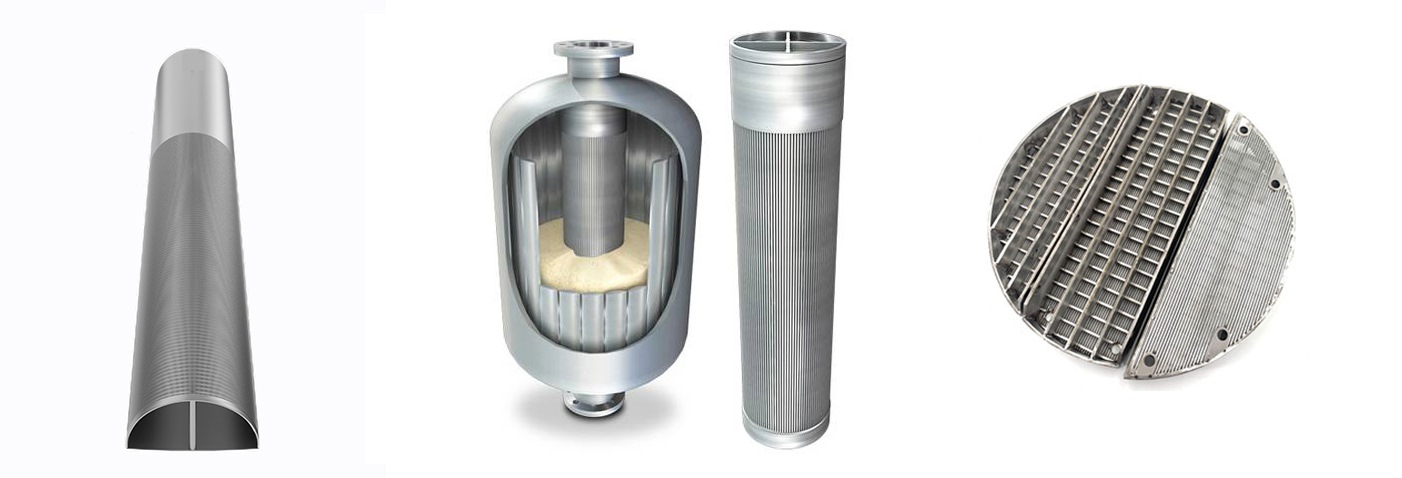
Reactor internal systems in oil refinery reactors are composed of several key components that work together to manage flow distribution, support catalyst beds, and ensure stable reactor operation. Each component plays a specific functional role within the system.
Oil refinery reactors typically use four main internal components that operate together as an integrated system.
The center pipe is the core flow collection and distribution element in radial flow reactors. It helps maintain balanced radial flow and stable pressure distribution across the catalyst bed.
In-depth Reading: Center Pipe Design Guide
Function:
Ensures uniform flow distribution
Reduces pressure imbalance
Improves reactor hydraulic stability
Scallops are used for catalyst retention and flow transition between reactor zones, helping maintain bed stability and prevent particle loss.
In-depth Reading: Scallops Design Guide
Function:
Prevents catalyst leakage
Maintains bed structure
Supports smooth flow transition
The support grid carries the catalyst bed and provides structural stability under high temperature and pressure conditions.
In-depth Reading: Support Grid Selection Guide for Reactor Internals | Catalyst Bed Support Design
Function:
Supports catalyst load
Prevents bed collapse
Ensures stable flow permeability
The wedge wire distributor ensures even flow distribution and reduces channeling inside the reactor.
Function:
Provides uniform flow distribution
Prevents channeling
Improves reaction efficiency
Although each component has a different function, reactor performance depends on their combined operation as a system.
Proper integration helps achieve:
Uniform flow distribution
Lower pressure drop
Stable catalyst operation
Longer service life
Poor design may cause flow channeling, catalyst loss, or reduced reactor efficiency.
Key factors in reactor internal design include:
Open area for flow efficiency
Pressure drop control
Material selection (SS304, SS316L, Duplex)
Mechanical strength under load
Reactor internal components are widely used in:
Hydrocracking reactors
Hydrotreating units
Catalytic reformers
Desulfurization systems
Wedge wire reactor internals are preferred due to:
High open area
Anti-clogging performance
Strong mechanical stability
Long service life
By combining advanced wedge wire technology with years of experience in refinery solutions, we help operators achieve greater process efficiency, lower maintenance costs, and improved safety. Whether you are upgrading an existing reactor or designing a new system, our reactor internals provide the dependable foundation for long-term refinery success.
Get Expert Solutions for Your Refinery Reactor Internals
Looking to upgrade or replace your reactor internals? At YUBO Filtration Equipment Co., Ltd., we design and manufacture wedge wire scallops, center pipes, catalyst support grids, hub laterals, and nozzles engineered for long-term refinery performance.
Contact our engineering team today to discuss your project requirements or request a custom quote.
FAQ About Oil Refinery Reactor Internals
Q1: What are reactor internals used for in oil refineries?
A: Reactor internals ensure proper fluid distribution, support catalyst beds, and maintain efficient flow paths inside refinery reactors. They are essential for maximizing catalyst performance, reducing pressure drop, and improving operational reliability.
Q2: What materials are reactor internals made from?
A: Most reactor internals are manufactured from stainless steel (304, 316L, 904L) or special alloys (Hastelloy, Inconel, Duplex stainless steel) to withstand high temperatures, pressure, and corrosive refinery environments.
Q3: How do wedge wire scallops improve reactor efficiency?
A: Wedge wire scallops support a radial flow reactor design, which distributes process fluids evenly across the catalyst bed. This reduces channeling, minimizes pressure drop, and extends catalyst life.
Q4: What is the function of a catalyst support grid?
A: Catalyst support grids hold the catalyst in place while preventing particle migration. They ensure stable operation, maintain catalyst integrity, and reduce downtime for maintenance or replacement.
Q5: Can reactor internals be customized for specific refinery processes?
A: Yes. Dimensions, slot sizes, open area percentage, and material grades can be fully customized to meet the technical specifications of hydrotreating, hydrocracking, catalytic reforming, and other refining processes.
Q6: How long do reactor internals typically last?
A: Service life depends on process conditions and material selection. With proper design and high-quality alloys, reactor internals can operate efficiently for many years before requiring replacement.
Did not find what you were looking for?
Send us a message and we will get back to you with the information that you need.
Structure of Refinery Reactor Internals

Contact Us

Industry
View All Applications
Wedge Wire Screens Provide Accurate Filtration Separation for the Water Treatment Industry: Common wedge wire products: filter nozzle,Distributor,basket strainer,resin trap, Cylindrical intake Screen.
Read More
Wedge wire screens are used in sugar mills, beverage factories, brewery plant, dairy factories, and other food processing plants, providing diverse solutions for pressure and pressureless filtration.
Read More
Typical Wedge Wire applications for the chemical, petrochemical & pharmaceutical market sector include,Header Lateral System,Filter Nozzle ,Center Pipe ,Scallop,Support Grid.
Read MoreRelated Products

Wedge wire is a robust, welded stainless steel structure commonly used for filtration, separation, and media retention. It features surface profiles, typically V-shaped wires, that are resistance-welded onto longitudinal support rods. This precise design ensures accurate slot openings, allowing filtrates to flow efficiently while effectively trapping solids.
Read More

Support grids are used in various Process vessels, reactor vessels, Gas absorbers, carbon filters, desulfurizers, molecular sieves, sand filters, gas sweeteners, and lauter tanks, media bed filters, hydrocarbon vessels.
Read More
The center pipe/inner screen is the central screening component in radial flow systems which is usually installed in radial flow reactor internals and collects or distributes the flow.
Read More
